| Aladdin | |
|---|---|
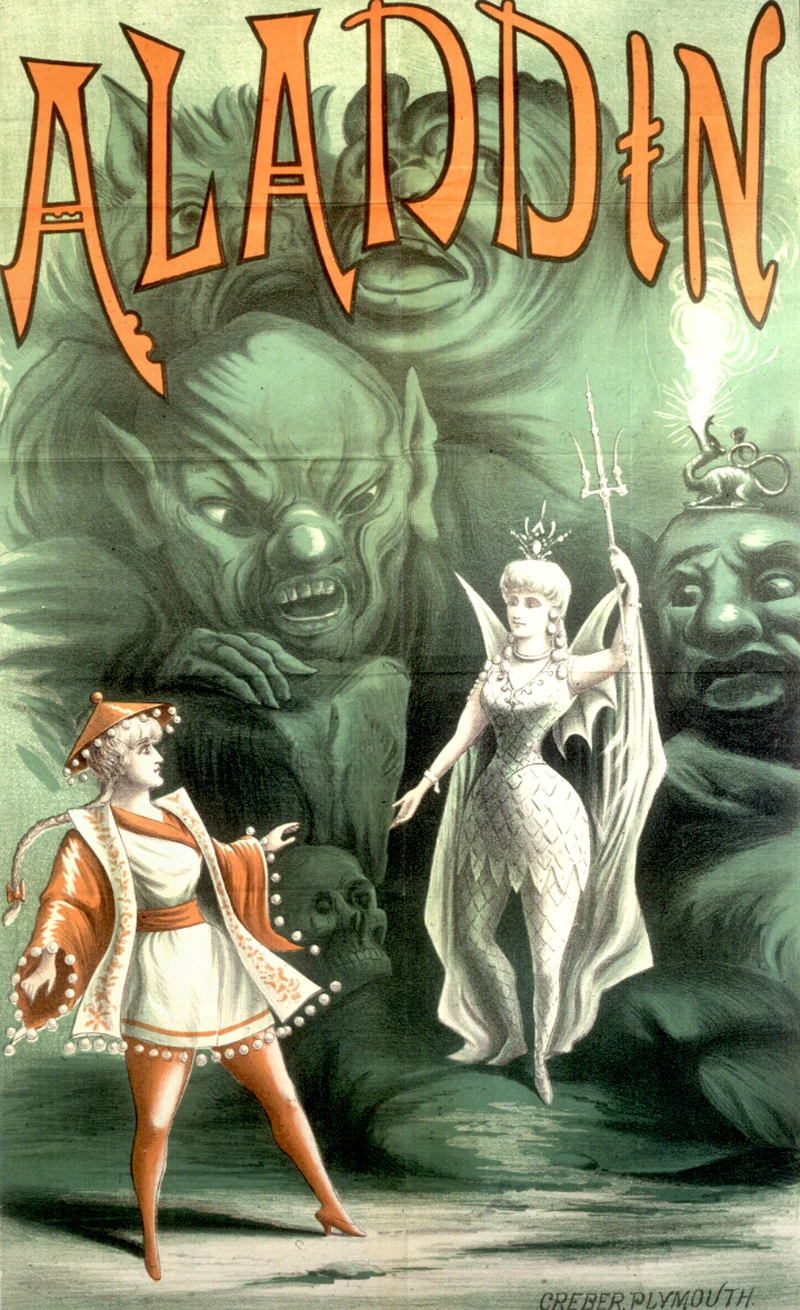 | |
|
Real Name |
Aladdin |
|
First Appearance |
Unknown |
|
Original Publisher |
Middle Eastern & Chinese Folklore |
|
Created by |
Unknown |
Origin
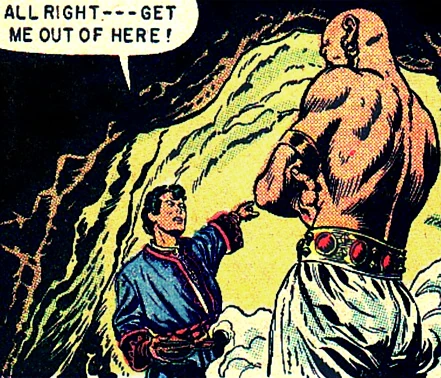

Aladdin is an impoverished young ne'er-do-well in a Chinese town, who is recruited by a sorcerer from the Maghreb, who passes himself off as the brother of Aladdin's late father Qaseem, convincing Aladdin and his mother of his goodwill by apparently making arrangements to set up the lad as a wealthy merchant. However the sorcerer's real motive is to persuade young Aladdin to retrieve a wonderful oil lamp from a booby-trapped magic cave of wonder. After the sorcerer attempts to double-cross him, Aladdin finds himself trapped in the cave.
Fortunately, Aladdin retains a magic ring lent to him by the sorcerer as protection. When he rubs his hands in despair, he inadvertently rubs the ring, and a jinn, or "genie", appears, who takes him home to his mother. Aladdin is still carrying the lamp, and when his mother tries to clean it, a second, far more powerful genie appears, who is bound to do the bidding of the person holding the lamp.
With the aid of the Genie of the Lamp, Aladdin becomes rich and powerful and marries Princess Badroulbadour, the Emperor's daughter (after magically foiling her marriage to the vizier's son). The genie builds Aladdin a wonderful palace – a far more magnificent one than that of the Emperor himself.
The sorcerer returns and is able to get his hands on the lamp by tricking Aladdin's wife, who is unaware of the lamp's importance, by offering to exchange "new lamps for old." He orders the genie of the lamp to take the palace along with all its contents to his home in the Maghreb. Fortunately, Aladdin retains the magic ring and is able to summon the lesser genie. Although the genie of the ring cannot directly undo any of the magic of the genie of the lamp, he is able to transport Aladdin to Maghreb, and help him recover his wife and the lamp and defeat the sorcerer.
The sorcerer's more powerful and evil brother tries to destroy Aladdin for killing his brother by disguising himself as an old woman known for her healing powers. Badroulbadour falls for his disguise, and commands the "woman" to stay in her palace in case of any illnesses. Aladdin is warned of this danger by the genie of the lamp and slays the imposter. Everyone lives happily ever after, Aladdin eventually succeeding to his father-in-law's throne.
Public Domain Appearances
All published appearances of Aladdin from before January 1, 1931 are public domain in the US.
Some notable appearances are listed below:
Public Domain Literary Appearances
- One Thousand and One Nights (1710)
- Aladdin (verse play), by Adam Oehlenschläger, 1805 (original, in Danish), 1808 (expanded version, in German). English translation Aladdin; or, The Wonderful Lamp: A Dramatic Poem—in Two Parts, translated by Theodore Martin, 1863.
- Alaeddin and the Enchanted Lamp; Zein ul Asnam and the King of the Jinn: Two Stories Done into English from the Recently Discovered Arabic Text by John Payne, 1901.
- The Blue Fairy Book (1889)
Public Domain Comic Appearances
- Fairy Tale Parade #4: The original tale.
- Dell Junior Treasury #2: The original tale.
- Jingle Jangle Comics #6: Aladdin frees the Genie after Bingo and Glum return his wife.
- Pep Comics (1940 series) #37
- Blue Beetle (1942 series) #23
- Military Comics (1941 series) #30
- Treasure Comics (1945 series) #3
- Green Hornet Comics (1942 series) #28
- Rocket Kelly (1945 series) #4
- Flip #1
Public Domain Film Appearances
- Aladdin and his Wonder Lamp (1906)
- Aladdin and the Wonderful Lamp (1917)
- Aladdin and the Wonderful Lamp (Indian) (1927)
Public Domain Animated Appearances
- Aladdin and the Wonderful Lamp (1934)
- Have You Got Any Castles? (1938)
- Aladdin and his Wonderful Lamp (1939)
- Foney Fables (1942)
- Mel-O-Toons: Aladdin (1959)
Notes
- While Aladdin possessed a magic carpet in the Disney film, Prince Husain is the character who buys a magic carpet in the original One Thousand and One Nights.
- The story of Aladdin is said to be set in China, but it features elements typical of the Islamic world, such as a sultan, Muslim characters and an absence of references to Chinese culture. Some suggest that the setting may be Turkestan, a Chinese region with Islamic influence. However, it is more likely that "China" is used simply as a symbol of an exotic and distant place, typical of Eastern fantasies of the time.
- In adaptations, especially the best-known ones, such as the Disney animation, the focus is only on the genie of the lamp, while the genie of the ring is omitted or merged into a single character to simplify the plot.